

Center for Cancer and Blood Disorders

The Center for Cancer and Blood Disorders provides comprehensive diagnosis and treatment for a full range of cancers and complex blood disorders, backed by advanced technologies and a multidisciplinary specialist team—with a 1-year survival rate that exceeds international benchmarks.
Clinical Outcomes
The 1-year survival rate for cancer patients aged 60 and above is 97% (data from 2019-2024), compared with the International Cancer Benchmarking Partnership's survival benchmark of 65-70%.
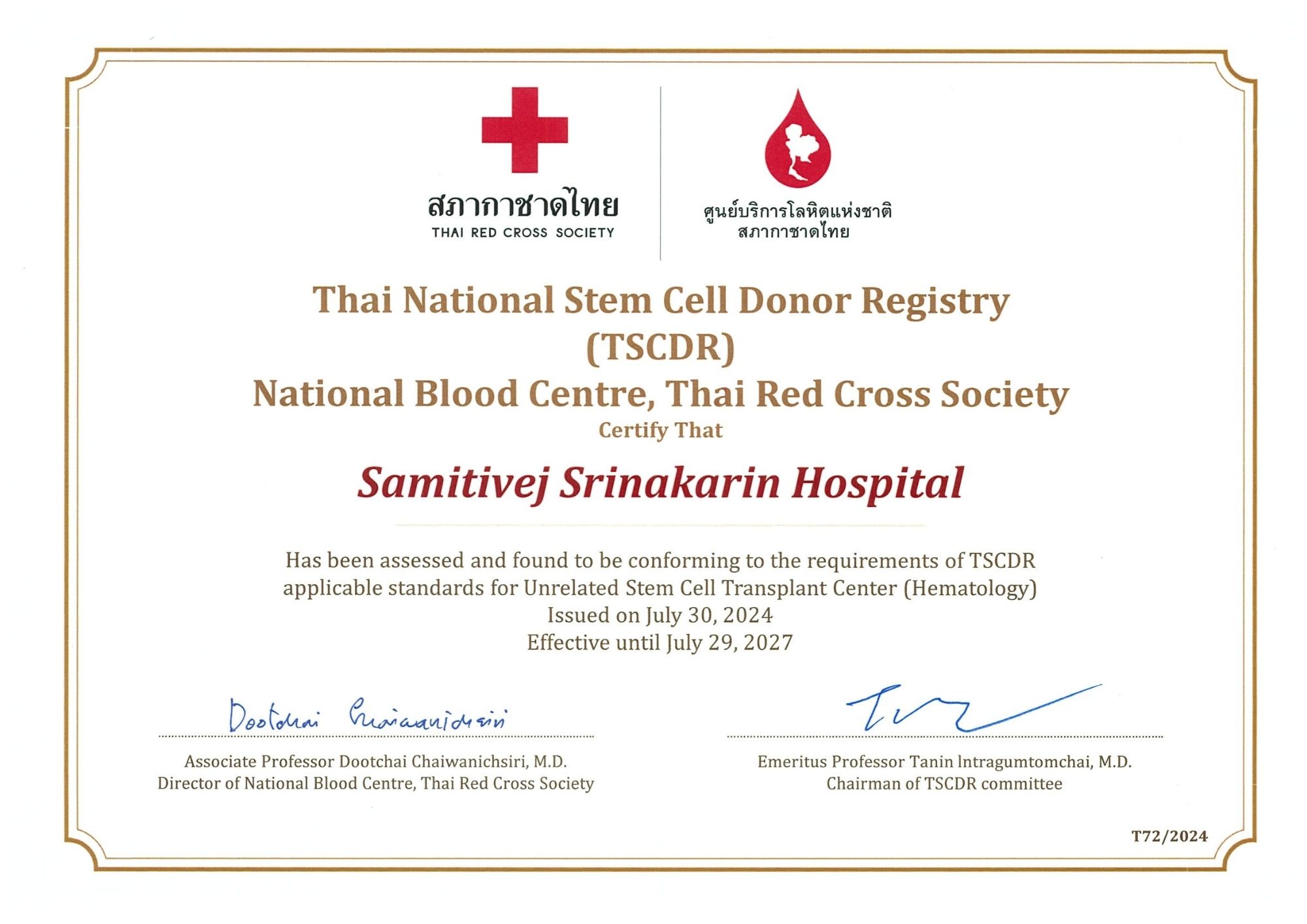
Accreditation from the Thai Red Cross Society
Samitivej Srinakarin Hospital has been accredited by the Thai National Stem Cell Donor Registry (TSCDR), under the National Blood Centre, Thai Red Cross Society, as an Unrelated Stem Cell Transplant Center (Hematology). This certification reflects the hospital’s standards in patient care, operational systems, and capability to provide advanced stem cell transplantation for patients requiring complex treatment.
Conditions Treated
- Solid tumors
Such as breast cancer, lung cancer, colon cancer, liver and bile duct cancer, gynecologic cancers, and other organ-based cancers. - Blood cancers
Such as leukemia, lymphoma, multiple myeloma, and complex hematologic disorders.
Advanced Medical Technologies in Cancer Treatment
- CAR T-cell therapy: a new dimension in cancer treatment in the form of immunotherapy.
- Samitivej offers CAR T-cell therapy for certain types of lymphoma and leukemia that do not respond to conventional treatments.
- The process involves collecting blood from the patient or donor, genetically modifying immune cells to target cancer, and reinfusing them into the patient.
- Locally produced CAR T-cell therapy in Thailand can cost more than five times less than imported therapies.
- Bone marrow and hematopoietic stem cell transplantation
- Autologous stem cell transplantation.
- Allogeneic stem cell transplantation, including:
a. Matched sibling donor transplantation.
b.Matched unrelated donor transplantation.
c.Haploidentical transplantation (50% match), using donors such as parents, children or siblings. This expands donor availability, especially for patients without a fully matched donor, improving access and reducing waiting time.
- Targeted therapy
Uses medications designed to act on specific molecules or pathways involved in cancer growth and spread, allowing more precise treatment with less impact on normal cells compared with traditional chemotherapy. - Advanced surgical technologies
Modern cancer surgery focuses on precision and minimizing physical impact, including minimally invasive surgery that reduces tissue damage and surgical trauma. - Gene therapy
This approach applies biotechnology to modify or regulate gene function within cancer cells, aiming to inhibit tumor growth or induce cancer cell death with greater precision. - Chimeric antigen receptor T cell (CAR-T cell therapy) for drug-resistant lymphoma and leukemia.
- Photopheresis
This advanced light-based technology is used to stimulate the immune system and reduce complications following stem cell transplantation.
Services of the Center for Cancer and Blood Disorders
- Risk assessment and cancer screening: Assessment based on age, gender, family history, symptoms, and individual risk factors to select appropriate screening tests, including for breast cancer, colon cancer, gynecologic cancers, or other cancers as indicated.
- Diagnosis and staging: Accurate cancer treatment planning begins with proper diagnosis. Investigations are performed to detect, monitor, and assess the disease; biopsy and pathology results are then used to determine the most appropriate treatment plan for each patient.
- Donor coordination: For patients without a suitable donor within the family, the hospital provides coordination services to search for stem cell donors externally, including collaboration with relevant organizations and networks to support continued access to treatment.
- Treatment
Systemic treatment: May include chemotherapy, hormone therapy, targeted therapy, or immunotherapy, depending on the cancer type and individual test results.
Cancer surgery: Remains an important treatment option for some patients, with oncologic surgeons and surgical teams planning treatment based on the tumor location, stage, and treatment goals.
Radiation therapy: Used in combination with surgery or chemotherapy, or for symptom relief in certain cancers. - Care for blood cancers and complex blood disorders: Patients with leukemia, lymphoma or complex blood disorders require care by hematologists and specialized teams.
- Follow-up, rehabilitation and quality of life care: After treatment, many patients require ongoing follow-up, management of complications, rehabilitation, nutritional support and psychological care to help them return to daily life as much as possible, as part of comprehensive cancer care.
- Cancer care for seniors: Cancer care for seniors differs from other age groups. In addition to the cancer type and stage, it is important to assess how well the patient can tolerate treatment. Seniors often have multiple comorbidities, frailty, reduced mobility and balance, poor nutritional status, cognitive or emotional concerns, and a dependency on multiple medications, all of which affect side effects, recovery and post-treatment quality of life.
- Palliative care: Provided by a multidisciplinary team working together in an integrated approach to deliver comprehensive care.
- Care for international patients: Services are tailored to meet the specific needs of international patients to ensure quality care at every stage.
- Before arrival
- Teleconsultation services are used to assess symptoms and plan treatment before travel.
- Aeromedical transport and repatriation services enable safe and timely patient transfer, with specialist medical teams accompanying critical cases.
- During treatment
- Dedicated coordinators manage appointments, answer inquiries and facilitate the treatment process.
- Professional interpreter services ensure accurate and effective medical communication.
- Concierge services provide personalized assistance and enhanced comfort throughout the treatment journey.
- After treatment
- Aeromedical transport and repatriation services ensure safe transfer or return, with continued care by the aeromedical team.
- Follow-up teleconsultation is used for ongoing monitoring and rehabilitation guidance to support continuous recovery.
- Before arrival
Facilities
- HEPA-filtered positive pressure rooms
- Dedicated bone marrow transplant rooms
- Private consultation rooms
- Connecting rooms for family members
- Isolation rooms
- Rooms specifically designed for chemotherapy administration
Our Medical team
- Oncology
- Radiation Oncology
- Surgery
- Critical Care Medicine
- Infectious Diseases
- Geriatric Medicine
الطبيب
Related
articles